The True Cost of Climbing Aconcagua (Updated for 2026/27)
By Sunny Stroeer

BY Sunny Stroeer, founder of AWExpeditions, who has set 2 Women’s Speed records on Aconcagua
Last Updated: October 2026, for the 2026/27 climbing season
I have spent a significant portion of my life on Aconcagua – the giant of the Andes which rises to 22,838ft (6,961 m) above sea level and is a coveted high altitude summit for expedition climbers of all experience levels. But what’s the real cost of climbing Aconcagua?
Last Updated: October 2026, for the 2026/27 climbing season
Whether you’re budgeting for your first expedition or refining plans for a repeat attempt on Aconcagua’s summit, this guide breaks down the full cost of a climb—from permits to gear to guided expeditions.
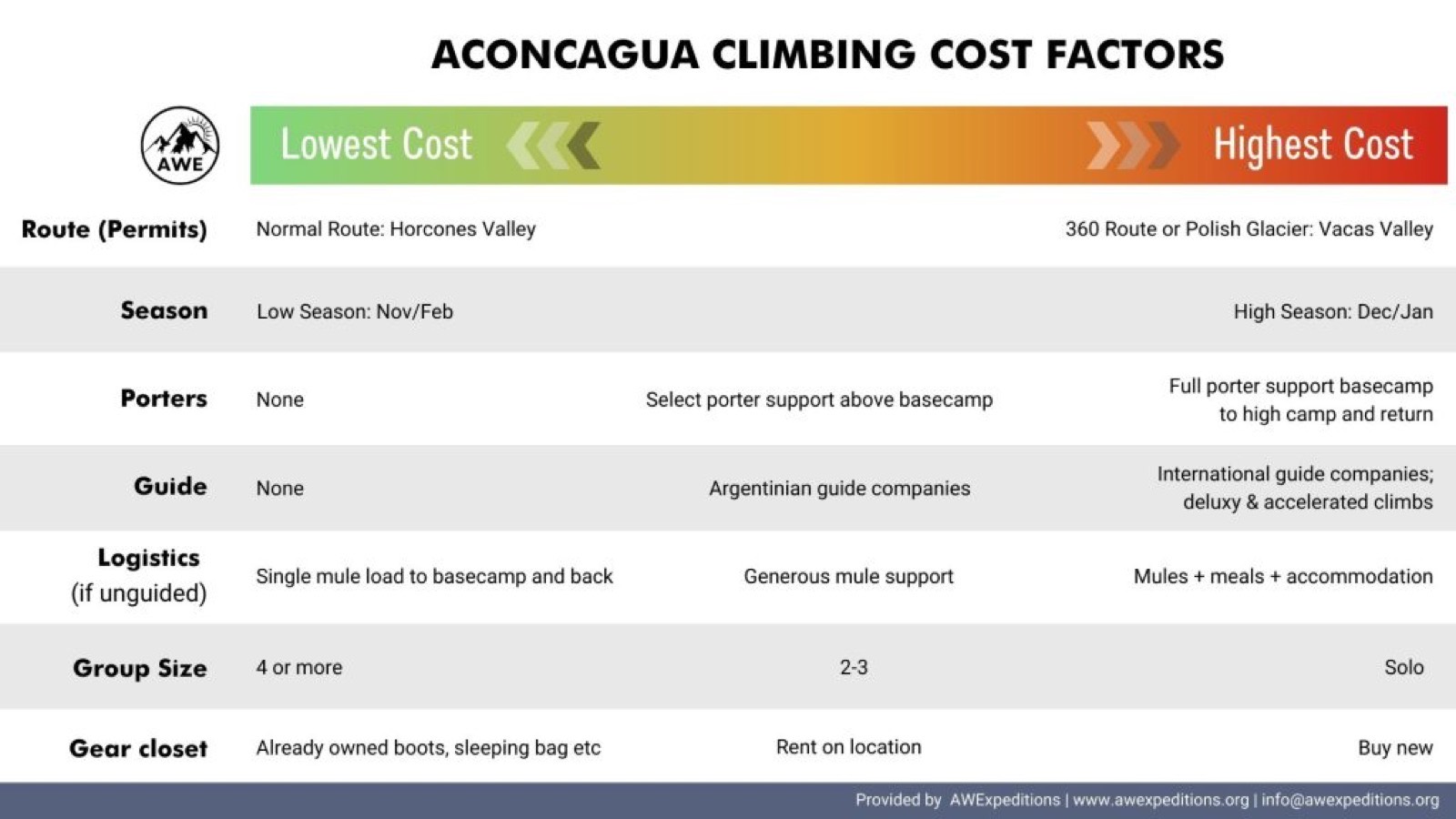
As you can tell, there are many different options for how to approach an Aconcagua climb; the above table yields too many permutations for me to price out each single one, but let’s take a look at some of the key cost drivers so you can understand what your levers are for managing the cost of your Aconcagua expedition.
Permits for Climbing Aconcagua
The first mandatory expense is your climbing permit, which the Mendoza provincial government requires to legally climb Aconcagua. Prices depend on your route and on whether you climb with a registered service provider. These are the foreigner rates for the 2025/26 season, the most recent full fee table published:
- Normal Route (Horcones Valley): $1,170 with a registered outfitter, $1,640 without
- 360 Route and Polish Glacier (Vacas Valley): $1,450 with a registered outfitter, $2,000 without
For 2026/27 the province ran an early-sale window from September 14 to 30, 2026, sold only through the park’s concession outfitters: $950 for the Normal Route and $1,290 for the Vacas Valley. The regular 2026/27 rates had not been published when I updated this post. I will add them once they are out.
Pro tip: The old high and low season pricing is gone. What saves you money now is buying early through a registered local outfitter. Climbers going fully independent pay the higher rate and don’t get the early-sale price. Prices are set in US dollars but paid in Argentine pesos at the Banco Nacion exchange rate. Permits are non-refundable and good for a maximum of 20 days. When you sign on to a commercial expedition, be it with an Argentinian outfitter or a “Western” guide company, the climbing permit is usually NOT included in your expedition fee.
Aconcagua Gear Costs: Renting vs. Buying
Aconcagua demands specialized, high-altitude gear. Depending on whether you’re buying new equipment or renting, gear costs can range from $1,500 to $3,000 and more:
- Sleeping Bag: Rated for extreme cold (-20°F/-28°C)
- Mountaineering Boots: Double or triple boots
- Technical Gear: Crampons, ice axe, and helmet
- Warm and Weatherproof Layers: Expedition-weight down jacket, GoreTex shell jacket and pants, high-altitude mittens
Renting gear can lower costs, but it’s essential to prioritize comfort and quality—especially for critical items like boots and sleeping bags. There are several rental shops in Mendoza that have a good selection of appropriate gear including double mountaineering boots, expedition parkas and warm sleeping bags.
Aconcagua Travel Costs: Flights and Transportation
Getting to Mendoza, Argentina is another significant cost. Round-trip flights from the US run roughly $900 to $2,400 depending on where you start, and holiday-season fares sit at the top of that range. Once in Mendoza, transportation to the trailhead (usually Penitentes) is an additional cost, typically $350+ for a shuttle or private transport.
Pro Tip: Book your flights 4-6 months in advance to secure the best prices. Also, make sure to keep an eye on baggage fees: if you are climbing Aconcagua independently, i.e. without a commercial expedition, you will need a minimum of two checked bags – even if you pack light. Excess luggage can quickly amount to hundreds of dollars of added fees.
Aconcagua Guided Expedition Costs: Is It Worth It?
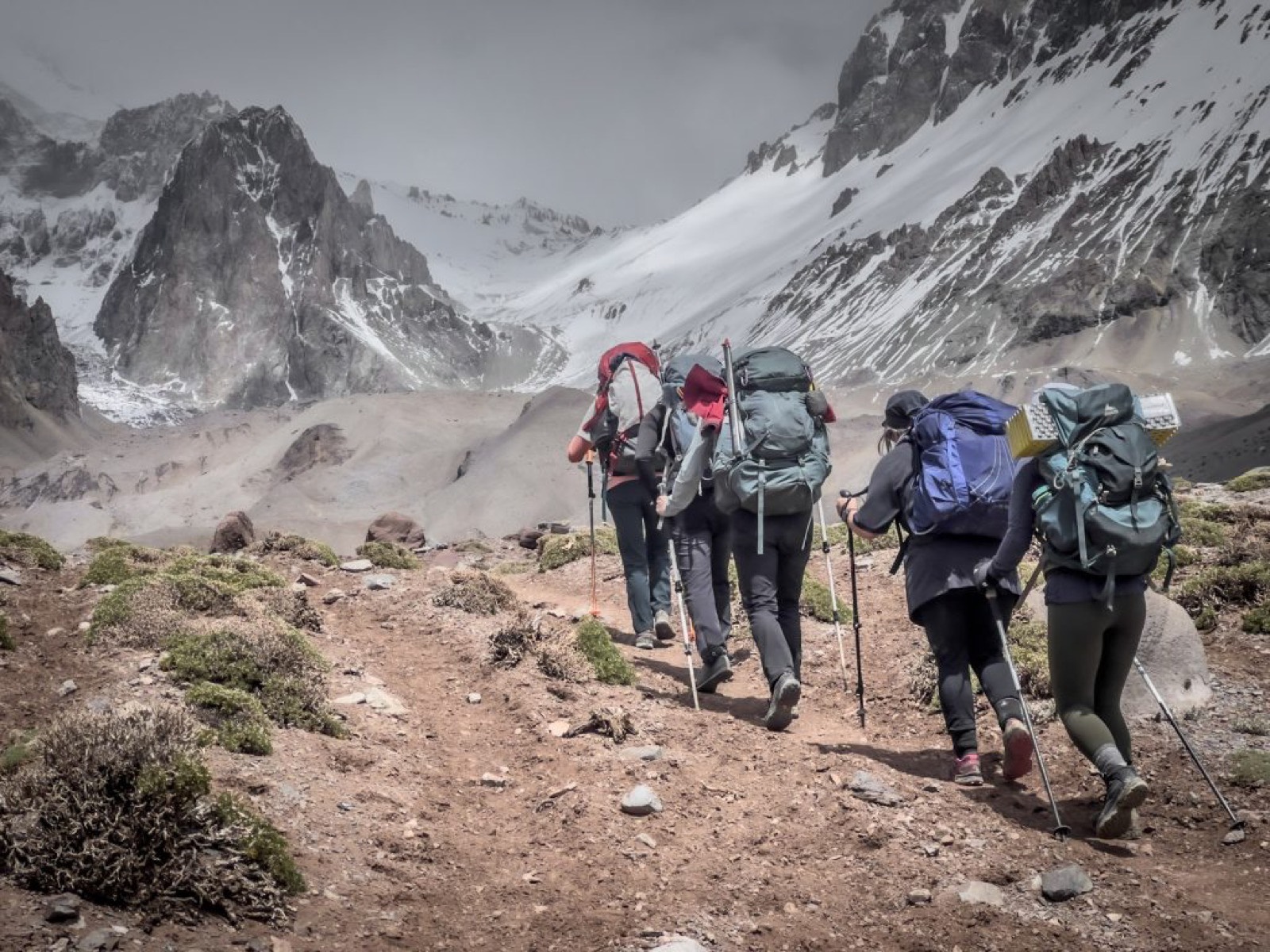
If you’re going on a guided expedition, you can expect to pay roughly $5,000 to $10,000 in expedition fees, depending on the company and the services provided. Fast-schedule trips with helicopter support cost a lot more. Full-service expeditions typically include:
- Guides, group gear and transportation
- Camp logistics: Including food, water, and tents
- Mules for equipment transport: Essential for high-altitude loads
Guided expeditions provide peace of mind and take much of the logistical stress out of the climb, allowing you to focus on summiting.
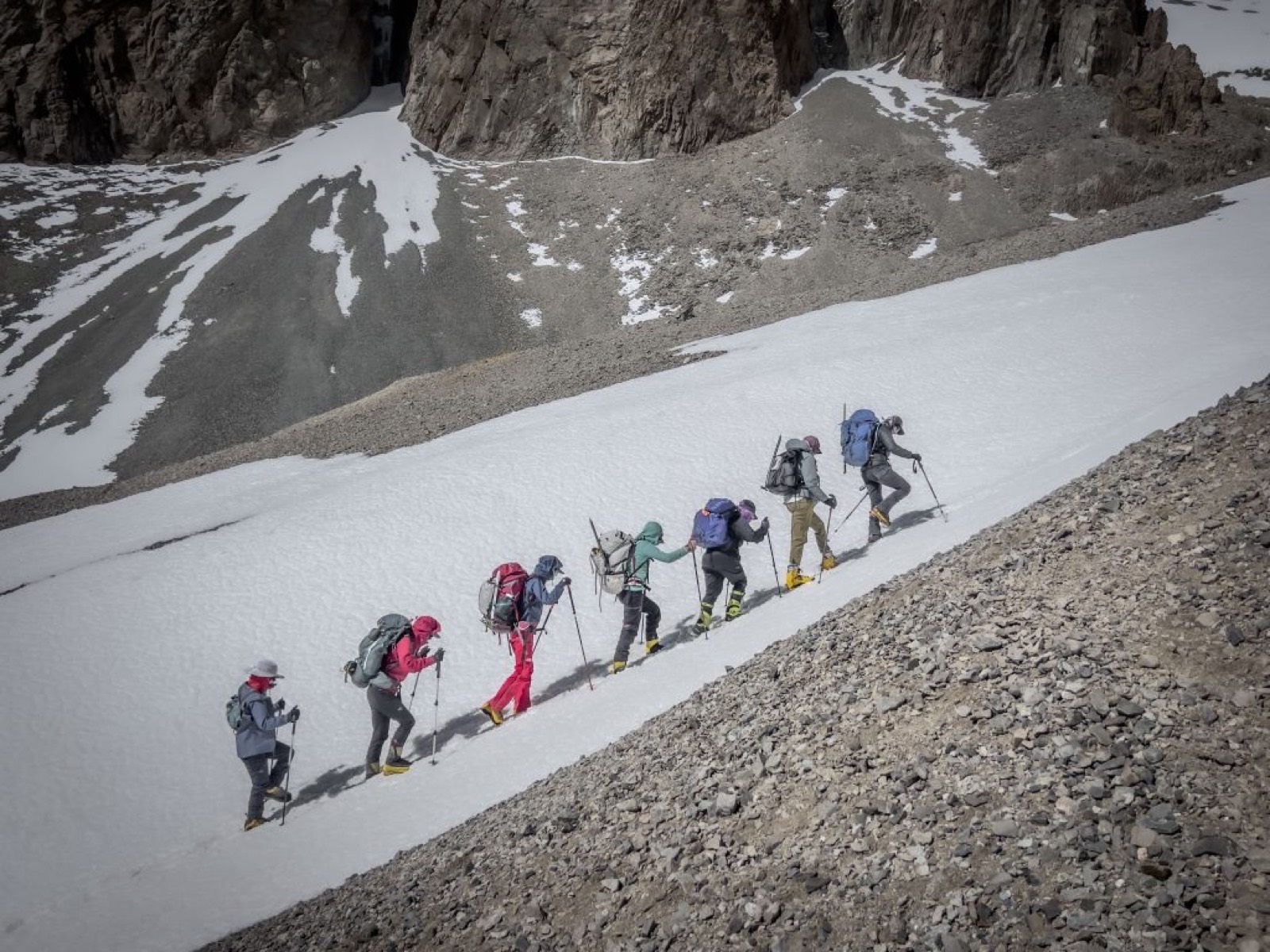
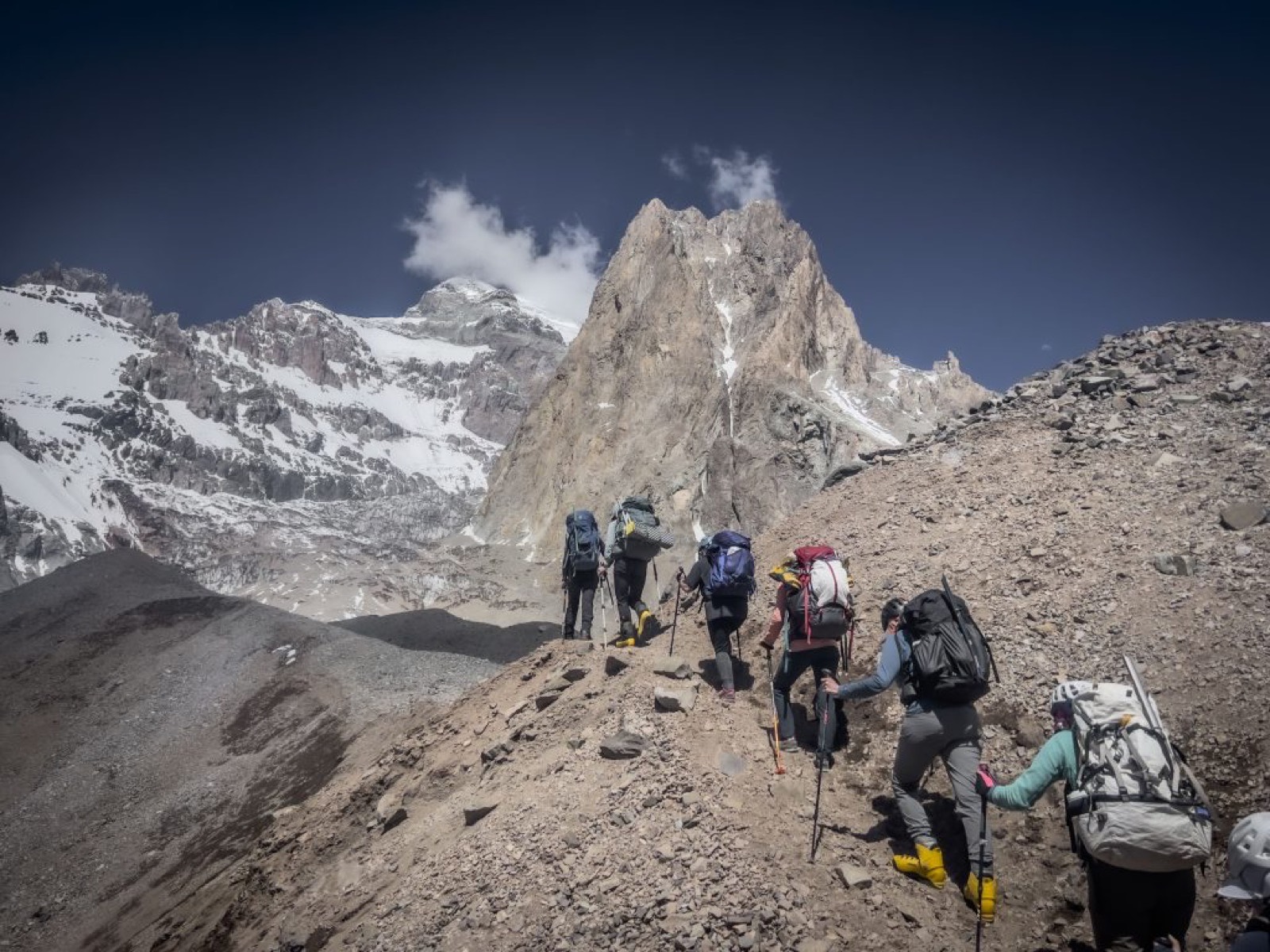
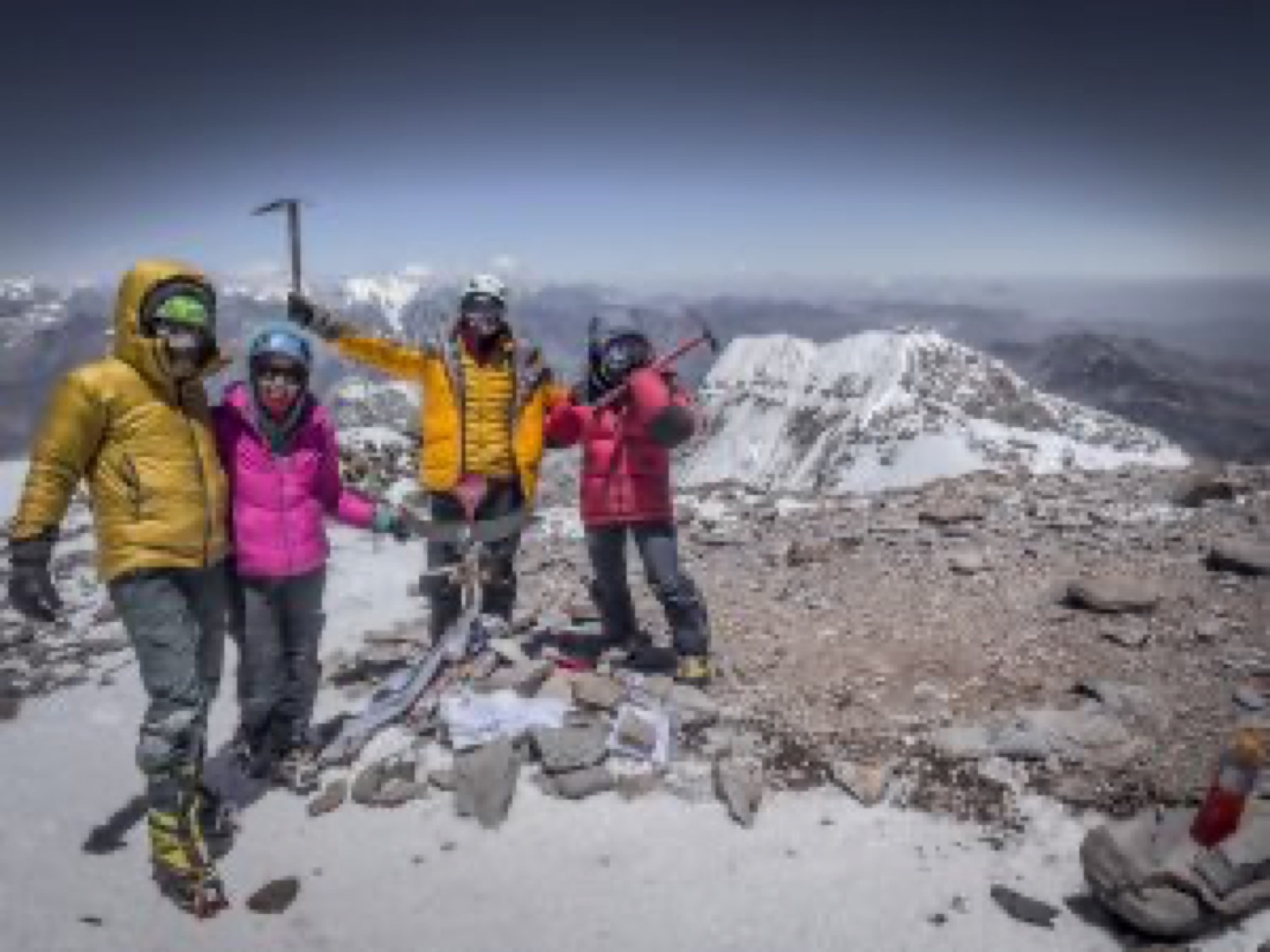
Are you considering joining a guided climb? Learn more about our all-women Aconcagua expeditions, led by expert women guides. See the trip page for our current price and what it includes. We also lead co-ed expedition teams on a private, custom basis.
Hidden Costs to Prepare For
Climbing Aconcagua comes with additional costs beyond the obvious expenses of permits, gear, flights, and guiding:
- Travel insurance: $200 to $400, make sure it covers high-altitude climbing
- Porters: optional, but many climbers hire one for part of the upper mountain. Expect about $185 to $400 per carry depending on how high it goes, for a standard 20 kg load, paid in cash in US dollars. A full carry package from base camp to high camp and back can run $1,000 to $1,500.
- Helicopter out of base camp: optional. A flight out has cost around $2,000 for three people, and some outfitters quote up to $2,000 to $3,000 roundtrip.
- Additional acclimatization: budget extra for accommodation and meals
- Miscellaneous: tips for guides and porters, base camp extras like showers, wifi and battery charging, and souvenirs ($300 to $600)
Pro Tip: Don’t forget evacuation insurance. It is mandatory: the park requires evacuation and medical assistance coverage that includes search, rescue and evacuation up to 5,500 m (18,000 ft), and your outfitter has to declare your insurer to the park. Without it you pay the rescue yourself. In 2025/26 the park charged $1,800 for an evacuation from the lower valley and up to $5,700 from the high camps, and close to $10,000 for a transfer to Mendoza.
Why Join an All-Women Aconcagua Expedition?
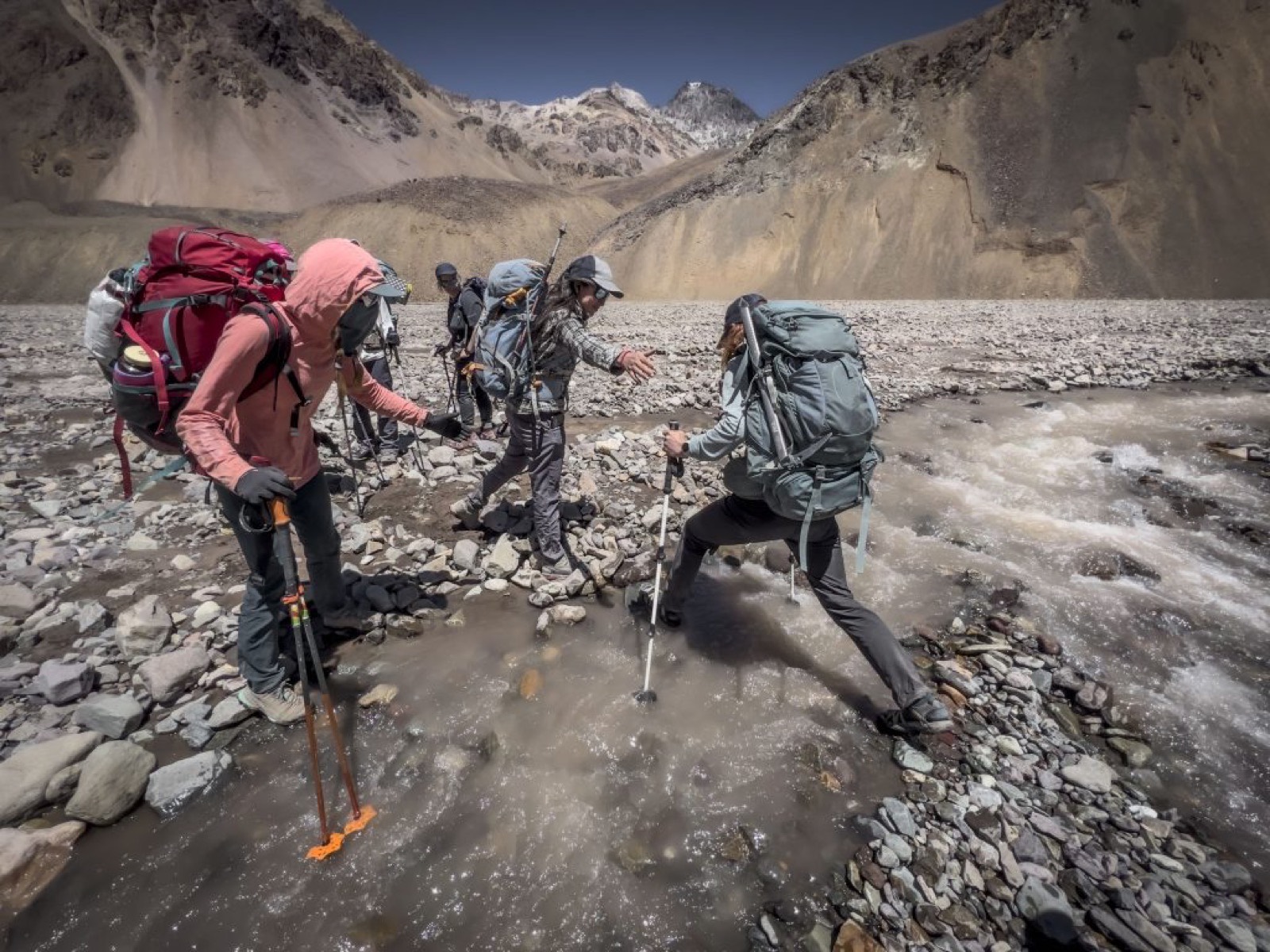
While this guide is for everyone, if you’re a female climber, you may find that an all-women expedition offers something unique. AWExpeditions specializes in creating an empowering environment for women to climb and adventure together, led by expert female guides. Many women find that the camaraderie and support that comes with a thoughtfully led all-women team is a completely different (and wonderful!) experience from many co-ed adventures.
Learn more about our all-women expeditions and how they can make your summit experience unforgettable. Join us for the next season of Aconcagua climbs.
The Bottom Line: Total Estimated Costs
Taking into account permits, gear, flights, accommodation, food and guided services, the total cost of a guided Aconcagua climb now runs roughly $9,000 to $18,000. It is a big number, and it buys a real shot at the summit of one of the Seven Summits.
Ready to start planning? Our free Aconcagua Expedition Budget Planner is a spreadsheet for mapping out your own costs.
Conclusion
Climbing Aconcagua is a serious financial and physical commitment, but for many, it’s a once-in-a-lifetime experience. By understanding the full scope of costs—from gear and permits to guided services—you’ll be better prepared to tackle the adventure.
Want to make this your year to summit Aconcagua? Join an all-women expedition with AWExpeditions and take your place among those who’ve taken on the challenge of the second-tallest of the Seven Summits. Learn more and sign up today!
Bonus Content: Case Studies
Want to take a look at actual numbers? Here are two scenarios to give you an idea of where your money goes depending on which style you decide to climb Aconcagua in.
THE BUDGET APPROACH TO CLIMBING ACONCAGUA
Aconcagua Normal Route, Low Season, Unguided Party of 2
The ultimate low-cost climb of Aconcagua would be to climb the Normal Route as a party of two, unguided and without porter support but with basic mule logistics support. The table below uses actual figures from 2019, so read it for the structure of the costs, not the totals. Permits alone have gone up by several hundred dollars since then.

In short: if you and your climbing partner already own all the prerequisite gear (including double mountaineering boots, a four season tent and a -30F sleeping bag), are willing to go unguided and carry pretty much all of your gear yourself once you are above basecamp, it is still possible to climb Aconcagua for about $5,000 to $6,000 per person, door to door. If you are traveling solo, expect more. Independent climbers no longer get a cheaper low-season permit, and they pay the higher rate for climbing without a registered outfitter.
A note about mule support: I have climbed Aconcagua without the assistance of mules, and I cannot recommend this approach. Yes, mules are pricey (several hundred dollars to get your gear to basecamp, one way), but they are well worth the money. If you decide to skip the mules, you have to be prepared for two things:
1) You will be humping a 65-80lbs to your chosen basecamp, which means two to three very long and hot days of incredibly hard work before the real climbing even begins. Reaching basecamp exhausted does not set you up for success on the upper mountain.
2) The savings that you are hoping to pocket from not hiring mules will be partially offset by a higher permit fee. The government charges unsupported climbers a premium to deter this approach: in 2025/26 that was $1,640 instead of $1,170 on the Normal Route, and $2,000 instead of $1,450 from the Vacas Valley.
THE “TIME IS MONEY” APPROACH
High Season, 360 Route Accelerated Climb, Guided, with key gear purchases
On the top end of the spectrum here’s what you’re looking at if you decide to climb Aconcagua in the high season, via the 360 Route, guided as part of – in this example – one of Alpenglow Expeditions’ Rapid Ascent Teams. I have chosen to showcase Alpenglow here (a highly regarded, California-based expedition business) as they are among very few guide services who are in a position to offer safe accelerated climbing schedules. It’s a pricey option, but it may be well worth it: if you are tightly constrained on how much time you can spend away from your job / family / home but you have the money to spend, this may be your ticket.
For 2025/26 that trip was listed at $16,450, not including the climbing permit. The table below uses my original figures from 2019, so treat it as a floor.
[Warning: do NOT attempt to climb Aconcagua on an accelerated schedule without the preparation and guidance of a high-end guide service like Alpenglow. The preparation for these types of climbs involves special training and equipment including thorough pre-acclimatization through the use of hypobaric tents. Without such measures and proper supervision, you cannot shortcut the climbing schedule on Aconcagua; acclimatization cannot be shortchanged, and attempting to do so can be fatal.]
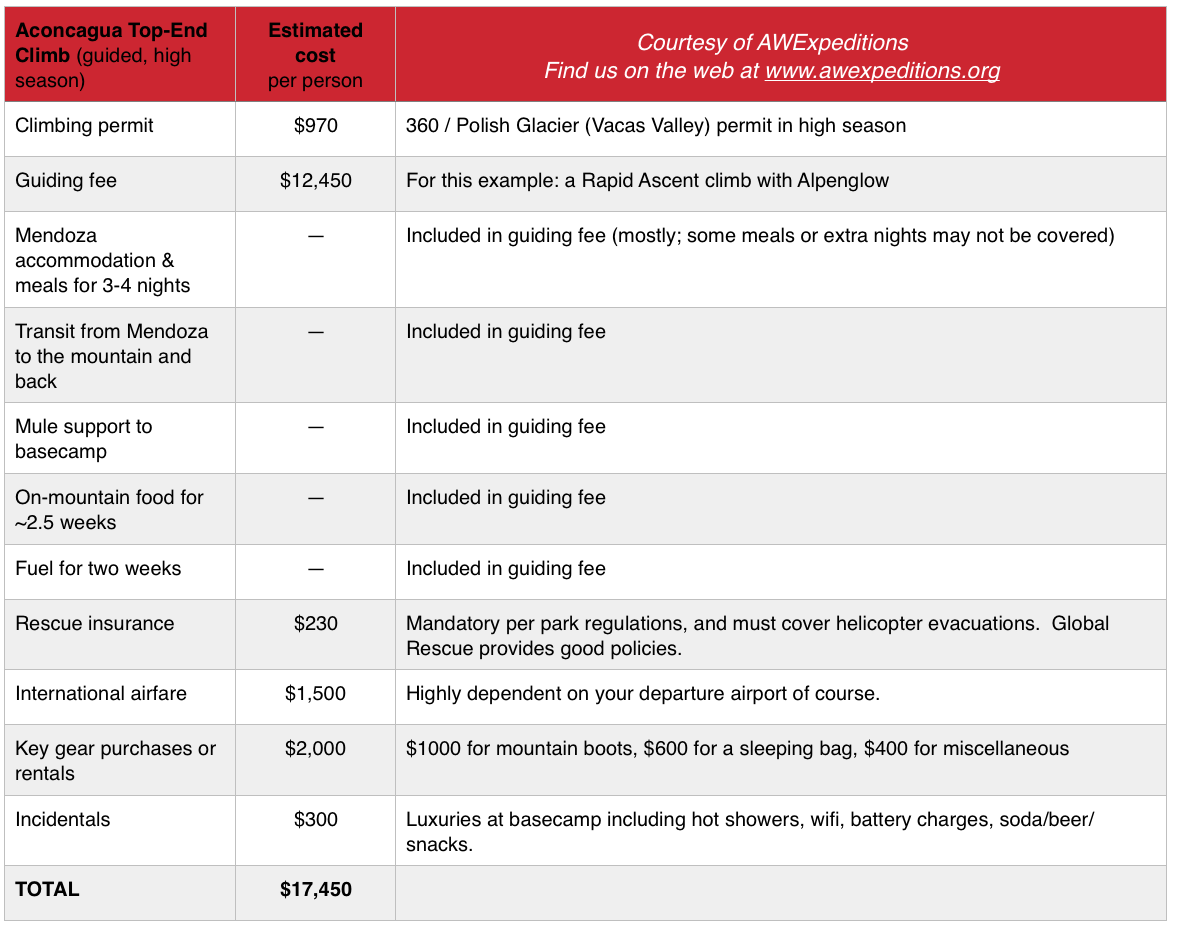
Of course it’s easily possible to spend even more money on an Aconcagua expedition. Business class flights, gear upgrades, generous guide tips and a few days of high-end Mendoza R&R can bring a deluxe Aconcagua climb to north of $25,000.
These are what I would consider the two extreme cornerstones of the cost spectrum for an Aconcagua climb: about $5,000 to $6,000 for a barebones unguided climb vs. $20,000 or more for a top-end guided climb with a fast schedule.
“The two extreme cornerstones of the cost spectrum for an Aconcagua climb: about $5,000 to $6,000 for a barebones unguided climb versus $20,000 or more for a top-end guided climb.“
Most Aconcagua hopefuls choose an option that falls somewhere between those two numbers: they tend to be both cost-aware yet are keen on a guided ascent, as being part of a guided team radically reduces the planning effort and takes a lot of the guess work out of your time on the mountain. This not just saves you time during your trip preparation, but also increases your odds of having a good and successful time on Aconcagua during your first go at the summit.
If you are interested in joining one of AWE’s all-women teams for an ascent of Aconcagua, check out our expedition details here.
If you’re in the planning stages of your own Aconcagua adventure, also check out the following resources: